
Exploring Rare Types of Pearls You Need to Know
The Master Craftsman’s Guide to Rare Luxury Pearls: Color, Engineering, and Design
In the world of high-end jewelry, pearls are often viewed through a traditional lens. At Coffin & Trout, we see them as a sophisticated fusion of organic wonder and structural potential. A luxury pearl is a gemstone engineered by nature over years of patient cultivation, and choosing one requires the same technical scrutiny you would apply to a rare diamond or a precision timepiece.
Whether we are integrating a luminous golden pearl into a custom setting or selecting a suite of peacock-toned Tahitian pearls for a necklace, our approach is rooted in education. We believe in sharing the technical nuances behind these gems to help you understand their true value. This guide explores the most sought-after colors in the pearl world, the physics of grading, and the specific design standards we use to ensure your pearl jewelry remains a lasting heirloom.
The Spectrum of Rarity: Coveted Pearl Colors
While many retailers offer generic white pearls, the rarity of a pearl is often defined by its natural hue and the specific environmental conditions required to produce it.
Golden South Sea Pearls: The Peak of Warmth
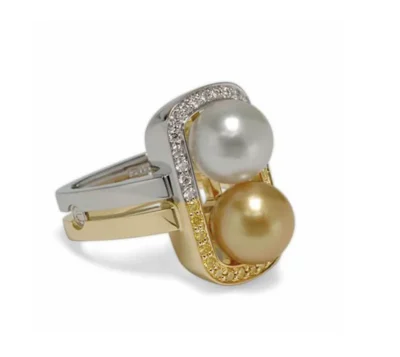
Cultivated in the Pinctada maxima oyster, South Sea pearls are the largest and most valuable cultured pearls in the world. While they can be found in a creamy white, the golden variety is the most coveted. These pearls are primarily sourced from the waters of Indonesia and the Philippines, where the oysters produce a deep, honeyed luster that cannot be replicated.
- Design Note: We frequently utilize Golden South Sea pearls to provide a warmth that complements 18k yellow gold.
- Featured Piece: The Escapade White and Golden Pearl Ring is a study in symmetry and contrast. To highlight the distinct beauty of each gem, we engineered a split-design aesthetic: one hemisphere features a white pearl set in white gold with white diamonds, while the other showcases a golden pearl accented by yellow gold and yellow diamonds.
Black Tahitian Pearls: Architectural Depth
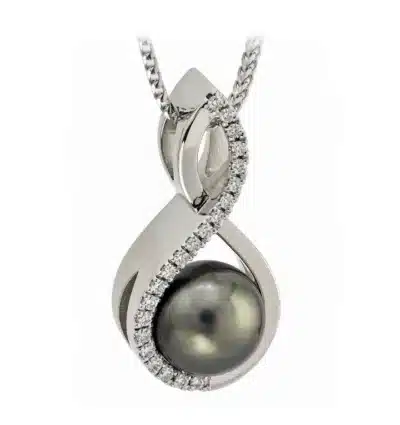
Originating from the black-lipped oyster in French Polynesia, Tahitian pearls are famous for their dark, metallic colors. Unlike dyed pearls found in mass-market jewelry, these hues are entirely natural, ranging from charcoal gray to the rare peacock green, which displays overtones of blue and purple.
- Design Note: To achieve a modern aesthetic, we select metals that best amplify the pearl’s specific secondary colors. White gold or platinum can provide a clean, seamless look or a sharp frame, while rose and yellow golds are frequently incorporated to draw out the hidden warmth and complex luster found deep within the nacre.
- Featured Piece: Explore the Escapade Black Tahitian Pearl White and Rose Gold Ring, where a dark Tahitian pearl is cradled in a square white gold bezel, creating a striking visual break against a broad, high-polished rose gold Paragon band.
Blue Pearls: The Rarest Optical Phenomena
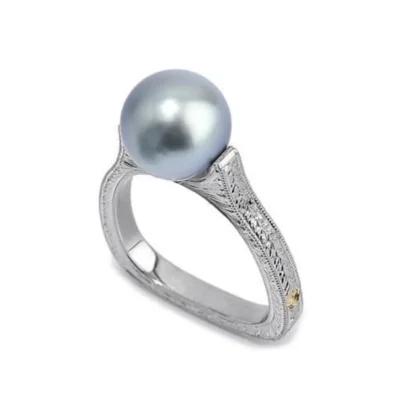
Among the most elusive colors in the gem world is the natural blue pearl. These occur when there is an anatomical accident during the pearl’s growth, often involving the presence of metabolic minerals or organic impurities between the nacre layers. These cool, serene tones range from soft silver-blue to a deep, electric azure.
- Design Note: Because blue is such a departure from traditional pearl palettes, it requires a setting that respects its rarity without overshadowing its natural luster.
- Featured Piece: The Paragon Tahitian Pearl White Gold Ring showcases how a soft, blue-toned pearl can be elevated by the clean lines of white gold.
Rare Tones: Pistachio and Keshi
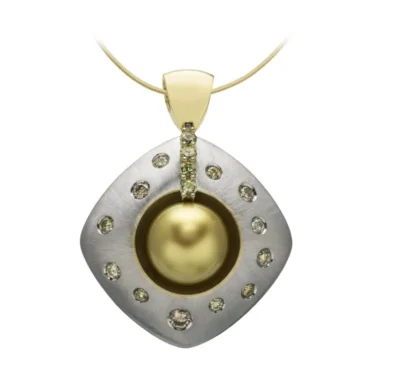
Beyond the classic colors lie the insider favorites. Pistachio pearls offer a unique, muted green-gold tint that is exceptionally rare in nature. Additionally, Keshi pearls—formed without a nucleus—consist of pure nacre. Because they are not shaped by a bead, they result in organic, irregular textures that we use for one-of-a-kind creations.
- Design Note: When working with pistachio tones, the metal choice is critical to the color’s expression. Warm metals like yellow gold can enrich the green-gold saturation, while white metals can lend a cooler, more contemporary feel to these rare, earthy hues.
- Featured Piece: Our Pistachio Pearl Fashion Necklace showcases how these subtle, rare colors can redefine a classic accessory.
Technical Grading: Beyond Surface Beauty
At Coffin & Trout, we look past standard industry shortcuts. While many use a simple A-AAA system, our curation process focuses on radiance and heirloom longevity.
Essential Grading Criteria
We reject pearls with thin nacre or blink, a phenomenon where the internal nucleus is visible through the surface. Like our diamonds, we curate for radiance, ensuring your jewelry never looks dull or chalky.
Solving the Pearl Problem: The Paragon Shape
A significant challenge with pearl rings is their tendency to spin. Because large South Sea or Tahitian pearls sit high off the finger, they often rotate uncomfortably. We solve this through our exclusive Paragon design.
Our rings are not round; they are engineered to follow the actual shape of the finger. This architectural approach provides several benefits:
- Stability: The pearl stays centered on the hand, allowing the design to be appreciated from every angle.
- Anatomical Fit: The shape allows the ring to slide over the knuckle easily while fitting snugly at the base of the finger.
True Creators: The In-House Difference
Unlike most jewelers who order finished pearl jewelry from third-party catalogs, we manufacture our pieces in our Chandler, Arizona studio. By using advanced CAD technology and master bench work, we maintain total control over the production process.
This allows us to hand-select each pearl to match a specific design and precisely engineer settings that protect the pearl while maximizing its exposure to light. We are makers, not just retailers, and we take full accountability for the quality of every piece that leaves our shop.
Preserving the Luster
Pearls are organic and require specific care to maintain their beauty for generations:
- The Last Step: Apply perfumes and hairsprays before putting on your pearls to avoid chemical damage to the nacre.
- Cleaning: After wearing, wipe your pearls with a soft, damp cloth to remove skin oils that can dull the surface.
- Storage: Avoid storing pearls in very dry environments, near direct heat, or inside airtight plastic bags. Plastic can emit chemicals that damage the surface, and an airtight seal prevents the pearl from “breathing,” which can eventually cause the nacre to become brittle. Additionally, always store pearls separately from other gemstones; with a hardness of only 2.5 to 4.5 on the Mohs scale, pearls are easily scratched by harder gems.

Discover the Collection
From the technical precision of our Paragon rings to the bold colors of our rare Tahitian and South Sea gems, we invite you to experience the Coffin & Trout difference. Explore our full Pearl Collection and discover a piece of future history.
If you are looking for something truly unique, we invite you to visit our Chandler studio to work directly with our artisans. Together, we can hand-select a rare pearl and engineer a custom setting that translates your vision into a structural masterpiece.
Frequently Asked Questions
What makes a “rare” pearl different from a standard luxury pearl?
Rarity is often driven by natural color and size. While high-quality white pearls are beautiful, colors like natural baby-blue, honey-gold South Sea, or peacock Tahitian only occur under specific environmental conditions. These unique colors, combined with superior luster and nacre thickness, represent the pinnacle of pearl collection.
Why does Coffin & Trout emphasize the Paragon shape for pearl rings?
Because luxury pearl varieties are often quite large, they create a top-heavy ring. A traditional round band will spin to the side of the finger. Our Paragon “Shape of the Finger” design provides the architectural stability needed to keep the pearl centered and upright, ensuring it is always displayed perfectly.
How does nacre thickness affect a pearl’s value?
Nacre is the crystalline substance that forms the pearl itself. At Coffin & Trout, we curate for high density and depth. Thick nacre not only creates a deeper, more iridescent luster but also ensures that the pearl remains a durable heirloom that won’t peel or lose its “glow” after years of wear.
Why is it important to store pearls separately from other jewelry?
On the Mohs scale of mineral hardness, pearls are very soft. Just about any other fine jewelry gemstone, and even gold settings, can easily scratch the surface of a pearl. Keeping them in a separate soft pouch ensures the delicate nacre remains unblemished.